
You are trying to install a new door hinge, but it won’t sit flush against the wood. A saw is too big, and sandpaper is too slow. This is exactly where a chisel shines. Whether you are a master carpenter or a weekend DIY warrior, the chisel is one of the most fundamental tools you can own.
But for the uninitiated, looking at a rack of sharp metal blades can be intimidating. Which one handles heavy impact? which one is for delicate shaving?
In this guide, we will break down exactly what is a chisel, explore the specific type of chisel for wood versus metal, and show you how to use them without ruining your workpiece—or your fingers.
The Anatomy of a Chisel
At its core, a chisel is a tool with a characteristically shaped cutting edge of blade on its end, for carving or cutting a hard material such as wood, stone, or metal. The design has remained relatively unchanged for thousands of years because it simply works.
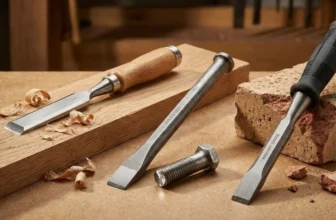
A standard chisel consists of a handle (made of wood or high-impact plastic) and a steel blade. The most critical part is the bevel. This is the angled grind at the tip that creates the cutting edge. The angle of this bevel dictates what the tool is used for. A lower angle is sharper but more fragile, perfect for slicing. A steeper angle is tougher, designed to withstand the blow of a mallet.
While they all look similar, using a wood chisel on a brick wall will destroy the tool instantly. Understanding the material capability is your first step toward mastery.
Main Categories: Wood vs. Cold vs. Masonry
Before we get into specific shapes, we need to distinguish the three main families of chisels. A type of chisel is defined largely by what it is meant to cut.
Table 1: The Three Main Chisel Families
| Chisel Family | Material Hardness | Handle Construction | Primary Use Case |
| Wood Chisel | Medium (Carbon Steel) | Wood or Plastic | Carving, joinery, shaving wood surfaces. |
| Cold Chisel | Hard (Tempered Steel) | Integrated Metal | Cutting cold metal, removing rivets, busting nuts. |
| Masonry Chisel | Very Hard | Integrated Metal (often with a guard) | Scoring brick, breaking concrete, cutting stone. |
Types of Wood Chisels
When people ask “what is a chisel,” they are usually picturing a wood chisel. However, even within woodwork, there are distinct variations. Choosing the wrong type of chisel for wood can result in sloppy joints or damaged handles.
The Bench Chisel
If you only buy one chisel, make it this one. The bench chisel is the workhorse of the shop. It usually features a beveled edge on the sides, allowing it to fit into tight corners like dovetails. It is short enough to control easily but long enough to provide good leverage. You can use this for paring (shaving) or chopping (striking with a mallet).
The Mortise Chisel
This tool is built like a tank. A mortise chisel is designed specifically for chopping out mortises—the square holes that receive a tenon in furniture joinery. The blade is thick and square, not beveled on the sides. It has a heavy bolster (the metal part between the handle and blade) to absorb the shock of heavy mallet blows. Do not use this for delicate shaving; it is meant for heavy excavation.
The Paring Chisel
On the opposite end of the spectrum is the paring chisel. These have long, thin, flexible blades. They are strictly for hand use. You never hit a paring chisel with a hammer. They are used to clean up joints and shave off thin slices of wood for a perfect fit. The long blade allows you to register the tool against a flat surface to keep your cuts straight.
Cold Chisels and Metalworking
You cannot use a wood chisel on metal. It will shatter. For metalworking, you need a cold chisel. The term “cold” implies that it is used to cut metal that has not been heated in a forge.
These are made from a single piece of octagonal steel. The most common variety is the Flat Chisel, used for cutting bars and rods to size. Another useful variation is the Cape Chisel, which has a narrower point designed to cut grooves or keyways into metal.
How to Use a Chisel Safely
Using a chisel effectively is about control, not brute force. Many beginners make the mistake of rushing the cut, which leads to the tool slipping.
The Grip and Stance
For detailed wood carving, hold the tool like a pencil near the blade for maximum control. For heavier chopping, grip the handle firmly with your dominant hand and place your other hand on the blade to guide it. Always ensure your body and hands are behind the cutting edge. A slip with a razor-sharp chisel can cause serious injury.
The Par and Chop Technique
When removing waste wood, don’t try to take it all out in one go. Work in layers. If you are cutting a recess for a hinge, score the outline first. Then, make a series of shallow cuts across the grain. Finally, use the chisel to pare away the waste down to your score line.
Table 2: Common Chiseling Mistakes
| Mistake | Consequence | Solution |
| Using a steel hammer on a wood handle | Mushroomed or split handle | Use a wooden or rubber mallet, or the palm of your hand. |
| Cutting against the grain | The wood tears out and splits | Always cut with the grain or across it, never against it. |
| Dull blade | Requires too much force, leads to slipping | Sharpen frequently. If it doesn’t shave arm hair, it’s dull. |
Maintenance: Sharpness is Safety
It sounds counterintuitive, but a sharp chisel is safer than a dull one. A dull chisel requires you to push harder. When you push harder, the tool is more likely to slip unpredictably.
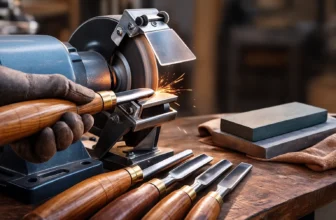
Invest in a simple sharpening stone or a diamond plate. You don’t need to grind the edge every time; usually, a quick hone on a fine stone is enough to bring the edge back to razor sharpness. Keep your chisels stored in a roll or a rack where the edges cannot bang against other metal tools.
Frequently Asked Questions (FAQ)
Can I use a screwdriver as a chisel?
Absolutely not. Screwdrivers are not made of the correct steel to withstand the impact or hold an edge. Using a screwdriver as a chisel can shatter the handle, bend the shaft, or damage the screw head profile, and it is a major safety hazard.
What is the best size chisel for a beginner?
If you are starting your collection, buy a set of three bench chisels: 1/4 inch (6mm), 1/2 inch (12mm), and 3/4 inch (19mm). These three sizes will cover 90% of general household and woodworking tasks.
What is the difference between a bevel-edge and a straight-edge chisel?
A bevel-edge chisel has the side edges ground down to an angle. This allows the chisel to fit into tight corners, like dovetail joints. A straight-edge chisel has square sides, making it stronger but less able to reach into angled corners.
How often should I sharpen my chisel?
You should hone your chisel as soon as you feel resistance. In professional woodworking, it is common to hone the blade every 20 to 30 minutes of continuous use. A quick touch-up prevents the need for heavy grinding later.
Can I use a wood chisel to remove old tile?
No. Ceramic tile and the mortar behind it are too hard for a wood chisel. You will chip the blade immediately. Use a masonry chisel or a specialized floor scraper with a carbide tip for tile removal.
The Final Cut: Carving Your Path to Mastery
Understanding what is a chisel opens up a new level of precision in your DIY and repair work. Whether you are framing a house or building a jewelry box, the ability to shave, pare, and chop material with accuracy is a superpower.
Remember, the tool does the work. If you are straining, the blade is dull, or you are using the wrong type. Respect the edge, choose the right chisel for the material, and always keep your hands behind the blade.
Ready to upgrade your toolbox?
Don’t settle for the rusty tool at the bottom of the drawer. Take a look at your current project and invest in a quality set of bench chisels today—your future projects (and your fingers) will thank you.


Hi, I’m Charles Larson. We do everything we can to support our readers with hundreds of hours of research and comparison testing to ensure you find the perfect tool for your workshop.