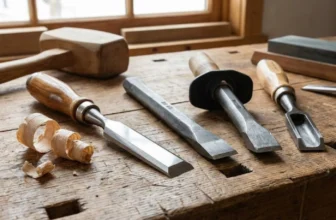
If you’ve ever admired the precise joinery on a vintage cabinet or the rugged texture of a stone sculpture, you’ve seen the work of a chisel. It’s one of the oldest tools in human history, yet it remains one of the most misunderstood by beginners.
At its core, a chisel is a tool designed to cut, carve, or shape hard materials like wood, stone, and metal. But grabbing just any chisel from the hardware store shelf is a recipe for frustration—or worse, a ruined project. A delicate paring chisel used on a brick wall will snap in seconds, while a cold chisel used on fine furniture will destroy the wood grain.
Understanding exactly what a chisel is used for (and which one to pick) is the difference between struggling with a job and mastering it. Whether you are framing a house, sculpting a statue, or just trying to get a hinge to sit flush, this guide will walk you through everything you need to know.
The Basics: What Does a Chisel Actually Do?
In simple terms, a chisel acts as a wedge. When you apply force to the handle—either by pushing it by hand or striking it with a mallet—the sharp metal edge drives into the material.
Depending on how you angle and drive the tool, a chisel can perform three main functions:
- Cutting: Severing wood fibers or metal sheets to create clean lines.
- Scraping: Removing glue, paint, or high spots from a flat surface.
- Shaping: Carving out complex 3D shapes, joints (like mortises), or decorative patterns.
While the concept is simple, the application varies wildly depending on the material you are working with.
Wood Chisels: The Carpenter’s Best Friend
When most people ask “what is a chisel used for,” they are usually thinking of woodworking. In carpentry and cabinetry, chisels are indispensable for joinery—the art of connecting two pieces of wood.
Common Woodworking Tasks
- Installing Hinges: You use a chisel to cut shallow recesses (mortises) so door hinges sit flush with the frame.
- Cleaning Joints: After cutting a dovetail or tenon with a saw, a chisel pares away the rough bits to ensure a perfect, airtight fit.
- Carving: Gouges (curved chisels) are used to scoop out wood for bowls, spoons, or artistic relief carvings.
The Different Types of Wood Chisels
Not all wood chisels are built the same. Here is a quick breakdown to help you spot the difference:
| Chisel Type | Best Used For | Key Feature |
| Bench Chisel | General purpose work (chopping & paring) | Beveled edges to fit into tight corners. |
| Mortise Chisel | Chopping deep, square holes for joints | Thick, heavy blade to withstand mallet pounding. |
| Paring Chisel | Delicate shaving and fine-tuning fits | Long, thin blade; never struck with a mallet. |
| Butt Chisel | Installing hardware (hinges, strike plates) | Short handle for control in tight spaces. |
Export to Sheets
Metal Chisels: Cutting the Uncuttable
You might be surprised to learn that chisels are standard equipment for mechanics and metalworkers. These are called cold chisels because they are used to cut metal in its “cold” state (without heating it up first).
Cold chisels are made from tempered carbon steel, making them tough enough to cut through bolts, rivets, and sheet metal without chipping.
Real-World Example: Imagine you have a rusted nut that absolutely refuses to budge. A wrench is useless. A mechanic will take a cold chisel and a heavy hammer to slice through the side of the nut, splitting it open so it can be removed.
Masonry and Stone Chisels
If you need to break up concrete, shape a stone block, or score a brick to snap it cleanly, you need a masonry chisel. These tools are generally duller and heavier than wood chisels. They don’t “slice” the material; they fracture it.
- Brick Bolster: A very wide, flat chisel used to cut bricks straight across.
- Point Chisel: Used for roughing out stone or breaking up concrete surfaces.
- Concrete Chisel: Often attached to power tools (like a hammer drill) to demo tile floors or break up driveways.
How to Use a Chisel (Without Hurting Yourself)
Using a chisel requires finesse, not just brute strength. Here is a step-by-step approach for a standard woodworking cut (like cutting a hinge recess).
Step 1: Score Your Lines Never start chiseling without a guide. Use a utility knife or the chisel edge to deeply score the outline of the area you want to remove. This severs the surface fibers and prevents the wood from splitting outside your lines.
Step 2: The “Bevel Down” vs. “Bevel Up” Rule * Bevel Up: For removing a lot of material quickly (digging in).
- Bevel Down: For smoothing and leveling a surface (using the chisel back as a guide).
Step 3: Parings, Not Chunks Don’t try to remove all the waste in one hit. Take thin slices. If you drive the chisel too deep, it will get stuck or split the wood uncontrollably.
Step 4: Use Your Body Weight For fine work, tuck your elbows in and use your body’s rocking motion to push the chisel, rather than just your arm muscles. This gives you far more control.
Pro Tip: If you are using a mallet, look at the tool’s handle. If the handle has a metal hoop at the end, it is designed to be hit. If it’s smooth wood or plastic with no reinforcement, it is likely a paring chisel—hand pressure only!
Safety First: Avoiding the “Red Workbench”
Chisels are statistically one of the most dangerous hand tools because people underestimate them. A sharp chisel is like a razor blade without a guard.
- Never cut towards yourself. This sounds obvious, but it is the #1 cause of chisel injuries. If the tool slips, it should fly into empty air, not your wrist.
- Keep both hands behind the blade. One hand guides the handle, the other guides the blade. If both hands are on the tool, neither hand can be cut by it.
- Don’t use a dull chisel. A dull tool requires more force to use. More force means that when it slips (and it will), it does so violently. Keep your tools razor-sharp.
FACommon Questions About Chisels
Can I use a wood chisel as a screwdriver or pry bar?
Absolutely not. The steel used in wood chisels is hard but brittle. Prying a paint lid or turning a screw will almost certainly snap the tip or chip the edge, ruining the tool.
How often do I need to sharpen my chisel?
Frequently. Many woodworkers give their chisel a quick hone on a leather strop or sharpening stone every 15–20 minutes of use. If the edge reflects light, it’s dull.
What is a “cold chisel” used for?
A cold chisel is used for cutting or shaping metal that has not been heated (hence “cold”). It is commonly used to remove rusted bolts, cut rivets, or shape sheet metal.
Why do some chisels have wooden handles and others plastic?
Plastic handles are durable and shatter-resistant, making them great for heavy construction work where you are using a metal hammer. Wooden handles offer better balance and comfort for fine woodworking but should generally be struck with a wooden mallet, not a metal hammer.
What is the difference between a gouge and a chisel?
A standard chisel has a flat blade. A gouge has a curved blade (like a scoop). Gouges are used for carving hollows, bowls, and flutes.
Conclusion
So, what is a chisel used for? It is used for control. Whether you are fitting a door hinge, freeing a seized nut, or sculpting a masterpiece, the chisel allows you to manipulate material with a precision that power tools often can’t match.
The key is matching the tool to the task. Don’t force a wood chisel to do a cold chisel’s job, and keep your edges sharp.Ready to get started? Go check your toolbox. If you have old, rusty chisels with chipped edges, don’t throw them away. Your next step is to pick up a simple sharpening stone and learn to restore that edge. You will be



Hi, I’m Charles Larson. We do everything we can to support our readers with hundreds of hours of research and comparison testing to ensure you find the perfect tool for your workshop.