
So, you’ve caught the bug. You’ve seen a Silverado tower over traffic at a red light, or maybe a Wrangler crawling over a boulder like it was a speed bump, and you thought, “I need that.”
Lifting your truck or SUV is one of the most rewarding upgrades you can make. It changes the look, the stance, and the capability of your rig instantly. But if you’ve started Googling prices, you’ve probably noticed the numbers are all over the map. One forum guy says he did it for $300, while a shop is quoting you $4,000.
Why the massive gap? Because “lifting a truck” can mean anything from shoving some metal spacers above your springs to completely replacing your suspension geometry.
If you’re trying to budget for a lift, you need real numbers, not guesses. This guide breaks down exactly what you’ll pay for parts and labor, plus the hidden costs that almost everyone forgets until it’s too late.
The Short Answer: What’s the Damage?
If you just want the bottom line before we dig into the details, here are the realistic price ranges you can expect in 2025 and 2026. These estimates include parts and professional labor.
- Leveling Kit (1–2.5 inches): $400 – $1,000
- Body Lift Kit (1–3 inches): $600 – $1,500
- Suspension Lift Kit (3–6 inches): $1,500 – $5,000+
- High-Performance/Coilover Lift: $4,000 – $10,000+
Note: These numbers are for the lift only. If you’re lifting your truck, you’re almost certainly adding bigger tires and wheels, which can easily double your total bill. We’ll get to that later.
Leveling Kits: The “Budget Friendly” Option
Cost range: $100–$500 (Parts) | $300–$500 (Labor)
If you just want your truck to sit level (raising the front to match the rear) or want to fit slightly bigger tires (like moving from a 31-inch to a 33-inch tire), a leveling kit is your best friend.
What you’re paying for:
You’re essentially buying spacers. For coil-spring trucks (like RAM 1500s or F-150s), these are pucks that sit on top of your struts. For torsion-bar trucks (older GMs), you’re buying new torsion keys.
- Pros: It’s cheap, keeps your factory ride quality mostly intact, and gets rid of that “nose-down” factory rake.
- Cons: It offers zero performance gain off-road. It’s strictly for looks and clearance for slightly larger rubber.
Verdict: If you rarely go off-road and just want a tougher stance, stop here. You don’t need to spend thousands.
Body Lift Kits: The “Show Truck” Special
Cost range: $200–$600 (Parts) | $500–$1,000 (Labor)
A body lift raises the actual cab and bed of the truck off the frame using blocks. Your frame and suspension stay at the same height, but your body sits 1 to 3 inches higher.
What you’re paying for:
The kit is cheap—mostly plastic or aluminum blocks and longer bolts. However, the labor is higher than a leveling kit because mechanics have to physically lift the cab, extend steering linkages, move bumpers, and adjust fuel filler necks.
- Pros: You get the height for bigger tires without messing with your suspension geometry.
- Cons: It can look gap-toothed. Because the frame stays low, you often see a visible gap between the frame and the bed. Plus, your ground clearance (the important part for off-roading) doesn’t actually change.
Verdict: Good for fitting 33s or 35s on a budget, but generally looked down upon by the serious off-road community.
Suspension Lift Kits: The Real Deal
Cost range: $1,000–$5,000+ (Parts) | $1,000–$2,000+ (Labor)
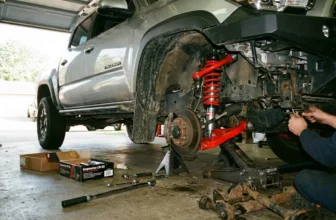
This is what most people mean when they say “lift kit.” You are replacing the actual suspension components—shocks, springs, control arms, and sometimes knuckles.
Entry-Level Suspension Lifts ($1,000 – $2,000)
At this price point (think brands like Rough Country or Zone Offroad), you’re getting the basics: taller coil springs, spacers, and basic shocks. You’ll get the height (usually 3 to 6 inches), but the ride might be stiffer than stock.
Mid-Range Performance Lifts ($2,500 – $4,500)
This is the sweet spot (brands like BDS, Bilstein, or Old Man Emu). You’re paying for better engineering. These kits often include:
- High-quality shocks: Monotube or remote reservoir shocks that handle heat better.
- Control arms: These correct your suspension angles so your truck can still be aligned properly and doesn’t drive like a boat.
- Leaf springs: Instead of just putting a block under your rear leaf springs (which causes “axle wrap”), these kits often give you entirely new leaf packs.
High-End/Coilover Systems ($5,000 – $10,000+)
If you see a truck flying through the desert in a Baja video, this is what they have. Brands like ICON, King, or Fox Racing offer coilover conversions. You aren’t just lifting the truck; you are completely transforming how it handles. It will ride better than stock, both on the highway and over whoops.
Verdict: If you plan on actually wheeling your truck, aim for the mid-range category. Cheap suspension lifts often lead to broken parts and a back-breaking ride.
The Labor Factor: Why Installation Costs Vary
You might see a kit online for $1,200 and think, “Great, that’s my budget.” Not so fast. Unless you are a skilled mechanic with a fully stocked garage, you are going to pay a shop to install it.
- Shop Rates: Mechanics charge anywhere from $100 to $200 per hour depending on where you live.
- Time: A basic leveling kit takes 2–3 hours. A full 6-inch suspension lift can take 10–15 hours.
Real-World Math:
If you buy a complex 6-inch lift kit for a modern F-150 (which requires cutting the subframe), a shop might bill you for 12 hours of labor. At $150/hour, that’s $1,800 just for installation.
Pro Tip: Don’t just hunt for the cheapest labor. Installing a lift involves cutting frames and messing with steering geometry. If it’s done wrong, it’s dangerous. Pay a shop that specializes in 4x4s, not a generic quick-lube place.
The Hidden Costs of Lifting a Truck
This is the section that saves your wallet. The “sticker price” of the lift is rarely the final price. Here are the things nobody tells you about until your truck is already on the lift.
1. Alignment ($100 – $200)
You must get an alignment immediately after installation. When you alter suspension height, you throw off the toe, caster, and camber. If you skip this, you will ruin your expensive new tires in less than 2,000 miles.
2. Wheels and Tires ($2,500 – $5,000)
Let’s be honest: a lifted truck on tiny stock tires looks like a roller skate. You’re going to want 35s or 37s.
- Tires: A set of quality All-Terrain or Mud-Terrain tires (like Nitto Ridge Grapplers or BFGoodrich KO2s) will run you $1,600 to $2,500.
- Wheels: Stock wheels often have too much “positive offset,” meaning they sit too far inside the wheel well and will rub against your new suspension parts. You’ll likely need aftermarket wheels with negative offset to push the tires out. Expect to pay $1,000 to $2,500 for a decent set.
3. Re-Gearing ($1,500 – $2,500)
This is the most overlooked cost. Your truck’s transmission is calibrated for stock tires. If you jump from a 31-inch tire to a 37-inch tire, you are effectively making your gears “taller.”
- The Result: Your truck will feel sluggish, the transmission will hunt for gears constantly, and your MPG will tank.
- The Fix: You need to change the ring and pinion gears in your differentials (front and rear). Parts and labor for this usually run about $1,000 per axle.
4. Speedometer Calibration ($200)
Bigger tires mean your speedometer will read slower than you are actually going. (e.g., your dash says 65 mph, but you’re doing 75 mph). You’ll need a calibration tool (like a Hypertech or Rough Country calibrator) to fix this and keep your odometer accurate.
5. Driveshaft Extensions ($500 – $1,000)
On some vehicles (especially Jeeps and short-wheelbase trucks), lifting the suspension changes the angle of the driveshaft too drastically. This can cause vibrations or even snap the driveshaft. You may need a “slip yoke eliminator” or extended driveshafts to fix the angle.
DIY vs. Professional Installation
Can you install a lift kit yourself to save that $1,500 in labor? Maybe.
You SHOULD NOT DIY if:
- The kit requires cutting and drilling the frame (common on Independent Front Suspension trucks like Silverados and F-150s).
- You don’t have heavy-duty jack stands and a floor jack that can reach high enough.
- You don’t have a torque wrench and knowledge of suspension safety (compressed coil springs can be deadly).
You CAN DIY if:
- It’s a simple leveling kit or a Jeep Wrangler (solid axle) lift that mostly involves unbolting and bolting.
- You have a buddy, a free weekend, and plenty of patience.
Summary: The “All-In” Price Breakdown
Let’s put it all together. Here is a realistic budget for a proper build on a standard 1500 pickup truck in 2025:
| Item | Estimated Cost |
| Mid-Range 6-Inch Lift Kit | $1,800 |
| Professional Installation | $1,500 |
| 35-Inch Tires (Set of 4) | $1,800 |
| Aftermarket Wheels (Set of 4) | $1,200 |
| Alignment | $150 |
| Speedometer Calibrator | $200 |
| Lug Nuts / TPMS Sensors | $150 |
| TOTAL PROJECT COST | $6,800 |
Wait, nearly $7,000? Yes. While you can do it cheaper by buying budget parts and skipping wheels, doing it right usually lands in the $5,000–$7,000 range.
Final Thoughts: Is It Worth It?
Despite the cost, lifting a truck is one of the few modifications that completely changes the personality of your vehicle. It gives you the clearance to go places stock trucks can’t, and let’s face it—it looks incredible.
Just make sure you budget for the whole package. There is nothing worse than a truck with a $3,000 lift kit sitting on stock tires because the owner ran out of cash. Plan ahead, buy quality parts that won’t rust out in a year, and enjoy the ride.


Hi, I’m Charles Larson. We do everything we can to support our readers with hundreds of hours of research and comparison testing to ensure you find the perfect tool for your workshop.