
If you are setting up a woodworking shop or looking to expand your DIY capabilities, you are likely staring at a common dilemma: Should you buy a scroll saw or a band saw?
At a glance, these two machines seem to occupy the same territory. They are both stationary power tools, they both feature tables to support your workpiece, and—most importantly—they are both designed primarily to cut curves. However, assuming they are interchangeable is a mistake that can lead to frustration, wasted money, and ruined projects.
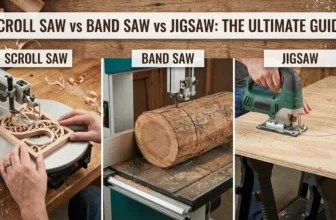
While they share some DNA, the scroll saw and the band saw are distinct tools designed for entirely different philosophies of cutting. The band saw is a muscular workhorse, built for structural cuts, resawing lumber, and aggressive curves. The scroll saw is an artist’s tool, designed for intricate detail, fretwork, and extreme precision.
In this guide, we will break down the mechanics, capabilities, pros, and cons of each machine to help you decide which one belongs in your workshop.
1. The Band Saw: The Workshop Workhorse
To understand the difference, we first need to look at the mechanics. A band saw gets its name from its blade: a continuous loop (or band) of metal with teeth on one side. This loop runs over two or three large wheels—usually one powered wheel and one idler wheel.
Because the blade moves in one continuous downward direction, the band saw offers a specific set of advantages. The cutting action helps hold the wood down against the table, providing stability.
Key Characteristics of the Band Saw:
- Power and Capacity: Band saws are generally more powerful than scroll saws. They can cut through thick hardwoods—some models can handle wood 6 to 12 inches thick (or more).
- The Blade: The blades vary in width, usually from 1/8 inch to 1 inch. A wider blade is stiff, making it excellent for cutting straight lines, while a narrower blade allows for tighter curves.
- The Kerf: The “kerf” is the slot of wood removed by the blade. Band saw blades remove a significant amount of material, leaving a rougher surface that almost always requires sanding.
Primary Uses:
The band saw is arguably the second most important tool in a general woodworking shop (after the table saw). It is used for:
- Resawing: Slicing a thick board into thinner veneers.
- Cutting Curves: Creating cabriole legs for furniture, arched headers, or rounded tabletops.
- Ripping Lumber: Making rough straight cuts on irregular wood that isn’t safe for a table saw.
2. The Scroll Saw: The Artist’s Brush
If the band saw is a machete, the scroll saw is a scalpel.
The scroll saw operates on a reciprocating mechanism. A very fine, short blade is clamped at the top and bottom of the machine. When turned on, the blade moves rapidly up and down.
Unlike the band saw, the scroll saw does not rely on a continuous loop. This mechanical difference is what gives the scroll saw its “superpower”: the ability to make inside cuts (pierce cuts). You can drill a hole in a piece of wood, unclamp one end of the scroll saw blade, thread it through the hole, re-clamp it, and cut out a shape from the center of the wood without cutting through the edge.
Key Characteristics of the Scroll Saw:
- Delicacy: Scroll saws use blades that can be as thin as a hair. This allows for essentially zero-radius turns. You can pivot the wood on a dime to create sharp corners.
- Safety: While all power tools carry risk, the scroll saw is considered one of the safest. The blade moves relatively slowly (in terms of linear feet per minute) and has low mass. It is very difficult to sever a finger on a scroll saw compared to other shop tools.
- Finish: The cut from a scroll saw is incredibly smooth. In many cases, the wood requires little to no sanding after the cut is made.
Primary Uses:
The scroll saw is specialized. It is the go-to tool for:
- Intarsia and Marquetry: Creating pictures using different species of wood fitted together like a puzzle.
- Fretwork: Cutting intricate, lacy patterns for ornaments, clock faces, or gingerbread trim.
- Lettering: Cutting names or signs out of wood.
3. Head-to-Head: The Major Differences
Now that we have defined the tools, let’s compare them across the categories that matter most to you as a user.
A. Cutting Capacity (Thickness)
This is the most obvious differentiator.
- Band Saw: Designed for thickness. Even a small 10-inch benchtop band saw can usually cut wood that is 3 to 4 inches thick. A floor-standing model can cut logs that are 12 inches thick. If you need to cut curves in a 4×4 post or a chair leg, the band saw is the only choice.
- Scroll Saw: Designed for thin stock. Most scroll saws top out at about 2 inches of thickness, but in reality, they struggle with anything over 3/4 inch or 1 inch. They excel with 1/8 inch plywood or 1/2 inch hardwoods.
B. Throat Depth and Width
“Throat depth” refers to the distance between the blade and the vertical frame of the saw. This dictates how wide a piece of wood you can manipulate.
- Scroll Saw: Usually has a deep throat (16 to 30 inches). This allows you to spin a large, flat panel 360 degrees to cut intricate designs in the center of a big project.
- Band Saw: Usually has a shallower throat (9 to 14 inches for standard shop models). Because band saws are used for structural parts rather than large flat panels, the throat depth is less of a priority than the vertical cutting height.
C. Inside Cuts (Pierce Cuts)
This is the deal-breaker feature for many crafters.
- Scroll Saw: Can perform inside cuts easily. This makes it possible to cut the letter “O” or “A” without cutting through the outside border.
- Band Saw: Cannot perform inside cuts. Because the blade is a continuous loop, the only way to cut a hole in the center of a board is to cut through the outside edge to get there, leaving a visible cut line that must be glued shut later.
D. Blade Action and Finish
- Band Saw: The continuous downward force holds the wood to the table, but the aggressive teeth leave “mill marks.” You will almost always need to follow up with a spindle sander or sandpaper.
- Scroll Saw: The up-and-down motion means the blade cuts on the downstroke but can lift the wood on the upstroke (causing “chatter”). A hold-down foot is required to keep the wood steady. However, the finish is satin-smooth.
4. Detailed Feature Comparison Table
To help you visualize the trade-offs, here is a direct comparison:
| Feature | Band Saw | Scroll Saw |
| Blade Motion | Continuous Loop (Down) | Reciprocating (Up & Down) |
| Max Material Thickness | 6″ to 12″+ (High Capacity) | Max 2″ (Best under 1″) |
| Blade Width | 1/8″ to 1″ | Very thin (Pin or Plain end) |
| Inside Cuts | Impossible | Yes (Excellent) |
| Surface Finish | Rough (Needs Sanding) | Smooth (Ready to finish) |
| Turning Radius | Limited by blade width | Zero-radius (Pivot on a point) |
| Primary Material | Lumber, thick stock, metal (with right blade) | Thin wood, veneer, plastic, bone |
| Noise Level | Moderate to Loud | Quiet (Humming) |
| Dust Generation | High | Low |
5. Which One Handles Which Project?
To make this practical, let’s look at specific projects. If you know what you want to make, the choice becomes obvious.
You Need a Band Saw If…
- You are making furniture. If you are building chairs, tables, or cabinets, you need the band saw to cut curved rails, legs, and supports.
- You want to “resaw” lumber. Buying thick lumber is cheaper than buying thin boards. A band saw allows you to buy a 4-inch thick board and slice it into four 1-inch boards. This alone can pay for the saw over time.
- You make bowls or turn wood. Woodturners love band saws because they use them to cut “blanks”—turning a square log into a rough circle before putting it on the lathe.
- You need speed. If you need to cut 50 curved brackets for a deck, the band saw will do it in a fraction of the time a scroll saw would take.
You Need a Scroll Saw If…
- You want to make puzzles. Wooden jigsaw puzzles require tiny, intricate cuts that fit together perfectly. Only a scroll saw can achieve this.
- You make Christmas ornaments. The ability to cut delicate snowflakes or reindeer silhouettes requires the finesse of a scroll saw.
- You are into “Intarsia.” This art form involves cutting different colored woods into shapes that fit together like a mosaic. The precision required for tight gaps is exclusive to the scroll saw.
- You have limited space and noise tolerance. A scroll saw is small, sits on a table, and is quiet enough to run in an apartment without disturbing neighbors.
6. The Learning Curve
It is worth noting that these two machines require different skill sets.
The Scroll Saw Learning Curve:
The scroll saw is easy to learn but hard to master.
- Beginner: You can sit down and make a passable cut on day one. It is not scary.
- Advanced: Mastering the “feed rate” to prevent burning the wood, learning how to make sharp turns without snapping the fragile blades, and managing blade tension takes practice. It is a meditative tool that requires patience.
The Band Saw Learning Curve:
The band saw requires more setup knowledge.
- Setup: A band saw must be “tuned.” You have to adjust the tracking (keeping the blade on the center of the wheels), the tension, and the guide bearings (which keep the blade from twisting). If a band saw is poorly tuned, it will drift—meaning you try to cut a straight line, but the blade wanders to the left or right.
- Operation: Once tuned, it is fairly easy to use, but you must respect the blade. It cuts flesh as easily as wood.
7. Cost Considerations
Both saws have a wide range of price points, but the entry-level requirements differ.
Scroll Saw Costs:
You can get a functional, entry-level scroll saw for $150 – $250. A high-end professional model (like a Hegner or Excalibur) can cost $500 – $1,000+.
- Note: Cheap scroll saws often vibrate excessively, which makes detailed work difficult.
Band Saw Costs:
A small benchtop band saw (9 or 10 inches) starts around $250 – $400. However, serious woodworkers usually upgrade to a 14-inch floor-standing model, which typically starts at $800 and goes up to $3,000+.
- Note: Cheap band saws often lack the power to resaw and have poor blade guides.
8. Can You Own Just One?
If you are strictly limited to one machine, which one should it be?
The Verdict: The Band Saw is More Versatile.
If you are a generalist woodworker who wants to build shelves, boxes, tables, and repairs, the band saw is the better investment. It can do 80% of what a scroll saw can do (albeit with less precision and more sanding), but it can also do heavy ripping and resawing that a scroll saw simply cannot touch.
The Exception:
If your primary interest is strictly crafts (toy making, signs, jewelry boxes, ornaments), the band saw will feel like using a sledgehammer to crack a nut. In that specific case, the scroll saw is the only logical choice.
9. Conclusion: Choosing Your Blade
Ultimately, the battle between the scroll saw and the band saw isn’t really a battle at all—it’s a choice between construction and creation.
Choose the Band Saw if your projects are measured in feet, bear weight, and require structural integrity. It is a machine of utility, essential for the furniture maker and the general woodworker.
Choose the Scroll Saw if your projects are measured in inches, require internal cutouts, and focus on aesthetics. It is a machine of artistry, essential for the pattern maker and the detail-oriented crafter.
Ideally, a well-equipped shop eventually includes both. The band saw cuts the wood to size, and the scroll saw adds the beautiful details that make the project unique.


Hi, I’m Charles Larson. We do everything we can to support our readers with hundreds of hours of research and comparison testing to ensure you find the perfect tool for your workshop.