
If you are setting up a workshop or diving into a new DIY project, you have likely encountered a common dilemma: Which saw do I actually need?
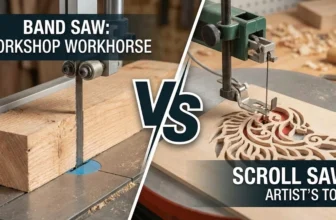
When you look at the tool aisle, you see three distinct tools that all claim to do the same thing: cut curves. The Jigsaw, the scroll saw, and the Band Saw are the “Big Three” of curved woodworking. Yet, despite their overlapping descriptions, they are radically different machines designed for radically different purposes.
Choosing the wrong one can lead to frustration, wasted materials, and projects that look nothing like the picture in your head. Choosing the right one, however, unlocks a level of creativity and precision that makes woodworking a joy.
In this comprehensive guide, we will break down the mechanics, pros, cons, and ideal uses for each saw. By the end, you will know exactly which machine earns a spot in your shop.
1. The Jigsaw: The Handheld “Jack-of-All-Trades”
If you are a homeowner or a beginner DIYer, the jigsaw is likely the first saw you will buy. It is the wild card of the workshop—portable, affordable, and surprisingly versatile.
What is it?
A jigsaw is a handheld power tool with a short, reciprocating blade that moves up and down rapidly. Unlike the other two saws on this list, the tool moves over the material, rather than the material moving through the tool.
How It Works
The motor drives a gear that converts rotary motion into a reciprocating (up-and-down) motion. Modern jigsaws feature orbital action, which moves the blade slightly forward on the upstroke and backward on the downstroke. This aggressive biting motion clears sawdust faster and allows for rapid, albeit rougher, cuts through thick lumber.
The Strengths (Pros)
- Portability: You can take the jigsaw to the work. If you are cutting a hole in a countertop for a sink or trimming a deck board outside, the jigsaw is your only option among the three.
- Plunge Cutting: This is a superpower unique to the jigsaw. You can start a cut in the middle of a panel without drilling a starter hole (with practice).
- Versatility: With the right blade, a jigsaw can cut wood, metal, plastic, ceramic tile, and laminate.
- Space & Cost: It fits in a drawer and costs a fraction of what a band saw costs.
The Weaknesses (Cons)
- Blade Deflection: This is the jigsaw’s Achilles heel. Because the blade is only supported at the top, it can bend or twist when cutting thick wood or tight curves. This results in a cut that is square on top but beveled on the bottom.
- Vibration: It is a handheld tool; holding it steady for long periods can be fatiguing.
- Lack of Precision: While great for rough curves, it is difficult to follow a line perfectly with a jigsaw compared to a stationary saw.
Best For:
- Construction and renovation projects.
- Breaking down large sheets of plywood.
- Rough cutting shapes that will be sanded later.
- Cutting holes in installed surfaces (sinks, vents).
2. The Scroll Saw: The Artist’s Brush
If the jigsaw is a sledgehammer, the scroll saw is a scalpel. This machine is designed for one thing: extreme precision.
What is it?
A scroll saw is a stationary machine with a small table. It uses a very fine, short blade clamped at both the top and bottom. The blade moves up and down vertically. It essentially acts like a powered coping saw.
How It Works
The reciprocating arm moves the blade at variable speeds. Because the blade is under tension (anchored at both ends), there is zero blade deflection. You can turn the wood on a dime, creating 90-degree corners instantly without cutting into the surrounding waste.
The Strengths (Pros)
- Intricate Detail: You can cut curves so tight they are practically invisible. This is the only machine capable of doing “fretwork” (highly detailed, lace-like patterns).
- Inside Cuts (Piercing): By drilling a small hole in your workpiece, you can unclamp the blade, thread it through the hole, re-clamp it, and make cuts inside the wood without breaking the outer frame.
- Safety: It is widely considered the safest power saw. The blade moves relatively slowly and has very little torque. If your finger touches the blade, you might get a nick, but you won’t lose a digit (unlike with a band saw or table saw).
- Finish Quality: The cut is so smooth that it often requires little to no sanding.
The Weaknesses (Cons)
- Speed: It is incredibly slow. Cutting a straight line on a scroll saw takes patience.
- Capacity: You are limited by the “throat depth” (the distance from the blade to the back of the machine). If you have a 16-inch scroll saw, you cannot cut to the center of a piece of wood wider than 32 inches.
- Thickness Limit: Most scroll saws struggle with wood thicker than ¾ inch or 1 inch. Hardwoods thicker than that will burn the blade or stall the machine.
Best For:
- Making wooden toys and puzzles.
- Intarsia and marquetry.
- Sign making.
- Christmas ornaments and delicate crafts.
3. The Band Saw: The Workshop Workhorse
The band saw is often regarded as the second most important stationary tool in a woodworking shop, right after the table saw. It is a beast of burden that combines the curve-cutting ability of a jigsaw with the power and ripping capacity of a table saw.
What is it?
A band saw features a long, continuous loop of metal blade welded into a circle. This band rides on two (or three) large wheels—one powered by a motor, the others idling. The blade runs continuously downward through the table.
How It Works
Because the blade is a continuous loop, the cutting action is seamless and downward. This pulls the wood firmly against the table, making it safer than a table saw where the blade rotates toward you (risking kickback).
The Strengths (Pros)
- Resawing: This is the band saw’s “killer app.” It can slice a thick board into thinner veneers. For example, you can turn a 6-inch thick log into six 1-inch thick boards. No other saw on this list can do this.
- Thick Stock: A decent band saw can cut curves in wood that is 6 to 12 inches thick without breaking a sweat.
- No Reciprocation: Because the blade goes in one direction (down), there is no vibration or “chatter” typical of jigsaws and scroll saws.
- Speed: It cuts fast and aggressive.
The Weaknesses (Cons)
- Inside Cuts: You cannot make inside cuts. Because the blade is a continuous loop, you cannot thread it through a hole. To cut a shape out of the center of a board, you must cut through the outer edge to get there.
- Footprint: While benchtop models exist, a proper band saw takes up significant floor space.
- Blade Changes: Changing and tensioning a band saw blade is a process that takes several minutes, unlike the seconds it takes to swap a jigsaw blade.
- Sanding Required: The saw marks left by a band saw are usually rough and require sanding or planing.
Best For:
- Cutting curves in thick furniture parts (cabriole legs, chair backs).
- Resawing lumber into veneers.
- Ripping rough lumber.
- Cutting circles and arcs.
Head-to-Head Comparisons
To truly understand which saw is right for you, we need to pit them against each other in specific categories.
1. Accuracy and Finish Quality
- Winner: Scroll Saw.
- Runner Up: Band Saw.
- Loser: Jigsaw.
If you need a cut that looks like it was laser-cut, the scroll saw wins. The blades can be as thin as a hair, removing very little material (kerf). The band saw is accurate but leaves ripple marks. The jigsaw is prone to wandering; even with a guide, the flexible blade often drifts off the line at the bottom of the cut.
2. Cutting Capacity (Thickness)
- Winner: Band Saw.
- Runner Up: Jigsaw.
- Loser: Scroll Saw.
The band saw is the king of thickness. A standard 14-inch band saw can usually cut wood up to 6 inches thick, and with a riser block, up to 12 inches. A jigsaw can technically cut 2-3 inches, but the blade will bend. The scroll saw is strictly for thin stock (under 1 inch).
3. Versatility and Portability
- Winner: Jigsaw.
- Runner Up: Band Saw (Versatility) / Scroll Saw (Portability – Tie).
The jigsaw is the only tool you can throw in a bag. It is also the only one that can cut a hole in a wall or a countertop. The band saw is versatile in the shop (ripping, crosscutting, circles), but it is immovable.
4. Inside Cuts (Fretwork)
- Winner: Scroll Saw.
- Runner Up: Jigsaw.
- Loser: Band Saw.
This is a binary category. The scroll saw excels at piercing cuts. The jigsaw can do it via “plunge cutting” or drilling a starter hole, but it lacks the finesse for small intricate holes. The band saw literally cannot do this.
Deep Dive: Blade Technology
The performance of these saws is heavily dictated by the blade you choose.
Jigsaw Blades: T-Shank vs. U-Shank
Modern jigsaws almost exclusively use T-Shank blades. They snap in and out without tools. Older models use U-Shank, which require a screw to tighten.
- Wood blades: Have large, spaced teeth for clearing dust.
- Metal blades: Have fine, wavy teeth.
- Reverse-tooth blades: Cut on the downstroke to prevent chipping the top surface of laminates.
Scroll Saw Blades: Pin vs. Pinless
- Pinned Blades: Have small cross-pins at the ends. They are easier to change but require a larger starter hole for inside cuts and cannot fit through very tight fretwork.
- Pinless (Plain End) Blades: Are just flat metal ends. They are harder to clamp but allow for microscopic entry holes and tighter turns. Serious scrollers only use pinless blades.
Band Saw Blades: TPI and Width
- Width: A wide blade (1/2″ to 3/4″) is for straight cuts and resawing. A narrow blade (1/8″ to 1/4″) is for tight curves.
- TPI (Teeth Per Inch): Low TPI (3-4) is for ripping thick wood fast. High TPI (10-14) is for smoother cuts in thinner material or metal.
Which Saw Fits Your User Profile?
Still undecided? Let’s look at three specific user profiles.
Profile A: The Home Renovator
You are: Fixing up a house, building a deck, installing laminate flooring, and occasionally building a simple bookshelf. You Need: A Jigsaw. Why: You need a tool that can travel from the garage to the kitchen. You need to cut around pipes, trim door casings, and cut 2x4s quickly. Precision is secondary to utility. A band saw is too heavy; a scroll saw is too delicate.
Profile B: The Fine Woodworker / Furniture Maker
You are: Building tables, chairs, and cabinets. You buy rough lumber to save money and mill it yourself. You Need: A Band Saw. Why: You need to process lumber. You will be cutting curves in table legs that are 2-3 inches thick. You might need to “resaw” an expensive piece of exotic wood to make drawer fronts. A jigsaw will ruin your expensive wood with non-square cuts, and a scroll saw is simply too small.
Profile C: The Crafter / Hobbyist
You are: Interested in making wooden toys, personalized name signs, Christmas ornaments, or intricate wall art. You have a small workspace, perhaps inside an apartment. You Need: A Scroll Saw. Why: Your work requires patience and detail, not brute force. You need a quiet machine (scroll saws are very quiet) that creates minimal dust compared to the others. You want to make things that look delicate and artistic.
Quick Comparison: Price Ranges & Top Brands (2025)
| Feature | Jigsaw (Handheld) | Scroll Saw (Benchtop) | Band Saw (Stationary) |
| Entry-Level Price | $30 – $80 | $120 – $250 | $200 – $400 |
| Best For: | Home DIY, rough cuts, demolition | Occasional crafters, simple shapes | Small crafts, light ripping |
| Mid-Range Price | $90 – $180 | $350 – $600 | $500 – $900 |
| Best For: | Serious DIY, precise cuts, remodeling | Dedicated hobbyists, intarsia | Serious hobby shops, furniture |
| Pro / Premium Price | $250 – $800+ | $800 – $1,500+ | $1,500 – $4,000+ |
| Best For: | Daily trade use, cabinet installation | Professional scrollers, marquetry | Professional woodworking, resawing |
| Top “Value” Brands | Ryobi, Skil, Black+Decker | WEN, Skil, Shop Fox | WEN, Rikon (10″ models), Ryobi |
| Top “Pro” Brands | Bosch, DeWalt, Makita, Milwaukee | DeWalt, King Industrial, Jet | Laguna, Rikon, Jet, Grizzly |
| Ultra-Premium | Festool (Carvex), Mafell | Hegner, Pegas | Powermatic, Harvey |
Detailed Market Breakdown
1. Jigsaws
- The “Gold Standard”: Bosch is widely considered the king of jigsaws. Their mid-range corded models (like the JS470E) are legendary for durability.
- The Luxury Pick: Festool jigsaws (starting around $475) are used by high-end cabinet makers because they have zero blade wander and integrated strobe lights that make the blade look like it’s standing still.
- Budget Tip: A Ryobi or Skil jigsaw is perfectly fine for cutting 2x4s or rough shapes, but they will vibrate significantly more than a Bosch or DeWalt.
2. Scroll Saws
- The “Gold Standard”: The DeWalt DW788 (approx. $500–$600) has been the market leader for two decades. It is the saw 80% of serious hobbyists eventually buy.
- The Budget King: WEN dominates the entry-level market. Their 16-inch variable speed saw (approx. $120) is arguably the best value tool in woodworking right now.
- The Luxury Pick: Hegner saws (German-made) cost $1,500+ and are built like tanks; they are designed to run for 8 hours a day for 30 years.
3. Band Saws
- The “Gold Standard”: Laguna and Rikon are the current leaders for serious home shops. Their 14-inch models (specifically the Rikon 10-326 or Laguna 14|12) feature “ceramic guides” which keep the blade incredibly straight.
- The Floor Space Factor: If you buy a cheap benchtop band saw (under $250), expect to be limited to thin wood (under 3 inches). If you want to “resaw” thick lumber, you must step up to the $1,200+ floor-standing models.
Common Questions (FAQ)
Q: Can a Scroll Saw cut your finger? A: Technically, yes, any saw can cut you. However, the scroll saw is the most forgiving. Because the skin is elastic and the blade stroke is short, you can often touch a running blade lightly without drawing blood. It is the best “first saw” for teaching children woodworking.
Q: Can I use a Jigsaw to cut perfectly straight lines? A: Generally, no. Even with a straight-edge guide clamped to the wood, the flexible blade of a jigsaw tends to wander. If you need perfectly straight cuts, you need a Circular Saw or a Table Saw.
Q: What is the “throat” size, and why does it matter? A: On Band Saws and Scroll Saws, the throat is the distance between the blade and the vertical frame column. If you have a 14-inch band saw, you cannot cut down the center of a 30-inch wide board because the board will hit the column. The throat defines the maximum width of material you can manipulate.
Q: Is a Band Saw safer than a Table Saw? A: Most woodworkers agree that yes, it is. The band saw does not suffer from “kickback” (where the wood is thrown violently back at the user) because the force of the blade is directed down into the table, pinning the wood in place.
Conclusion: The Ideal Progression
If you plan on getting serious about woodworking, the reality is that you might eventually own all three. They complement rather than replace each other.
However, for your first purchase, follow this rule of thumb:
- Buy a Jigsaw first if you need general utility for home repairs and simple projects. It is the cheapest entry point.
- Buy a Scroll Saw first if you are specifically interested in making small, detailed crafts and have limited space.
- Buy a Band Saw first if you are building furniture and need to process thick lumber.
The “best” saw isn’t about the specs on the box—it’s about matching the tool to the project you dream of building.


Hi, I’m Charles Larson. We do everything we can to support our readers with hundreds of hours of research and comparison testing to ensure you find the perfect tool for your workshop.